SEO and lead automation: from the search result to a handled enquiry
Most discussions of search visibility stop at the click. That is roughly half the job. The distance between somebody landing on your page and somebody receiving a useful reply is where a large share of marketing spend quietly evaporates.
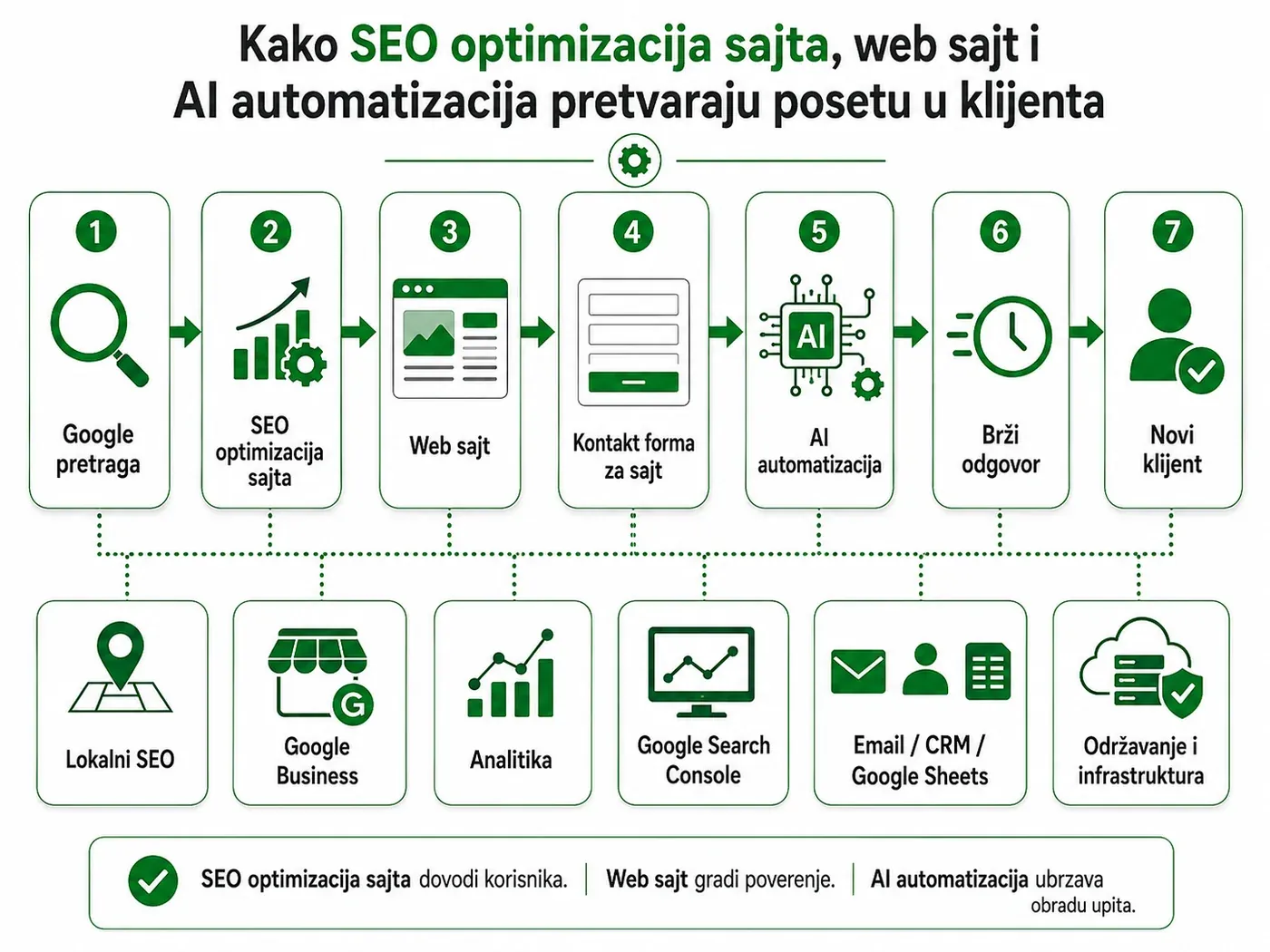
SEO determines how many relevant people find you. The landing page determines how many of them make contact. What happens after the form is submitted determines how many of those become customers. The three are one system, and the weakest link sets the result.
Automation is not about doing more marketing. It is about not wasting the marketing you already paid for.
A business invests in search visibility, the traffic goes up, and the number of new customers does not move as much as expected. The instinct is to conclude that SEO did not work. Usually SEO worked and something after it did not.
It is worth following the whole path, because each stage has its own failure mode and they are not interchangeable.
The chain from search to reply
Stripped to its essentials, the sequence is: a person has a problem, they search, they choose a result, they assess the page, they decide whether to make contact, they submit something, and somebody responds. Seven steps, and marketing attention is usually concentrated on the first four.
The last three are where the money is decided. A visitor who was ready to buy and got no reply for two days is a more expensive loss than one who never arrived, because you paid to bring the first one there.
How somebody actually reaches you
Organic search remains the dominant route for service businesses, and it splits into recognisably different behaviours. Some searches are informational, from people establishing whether they even need what you sell. Some are comparative. Some are ready to act, often phrased as a service plus a place.
Each behaviour should meet a different page. Sending a ready-to-buy local searcher to a general explainer article is a mismatch, and so is sending a researcher to a hard sales page. This is why content structure and search intent are the same conversation.
What on-site SEO covers
The work that decides whether you appear at all divides into three layers. The technical layer determines whether pages can be crawled, indexed and rendered: sitemaps, canonicals, redirects, structured data, speed and mobile behaviour. The structural layer determines which pages exist and how they relate. The content layer determines whether each page answers its query better than the alternatives.
All three are ongoing. Competitors publish, algorithms shift, and pages that were comprehensive two years ago are now merely adequate. Treating optimisation as a one-time configuration is the most common way to lose ground slowly.
The local layer, where it applies
If you serve a defined area, local search brings a different and usually higher-intent audience. It also depends on signals your website does not control on its own: your Google Business Profile, the consistency of your business details across the web, reviews, and the specificity of your service-area content.
The practical implication is that local visibility work has to happen in two places at once. A strong site with a neglected profile underperforms, and so does the reverse.
Arriving is not converting
Once somebody lands, you have a short window to answer three questions: is this relevant to me, can I trust it, and what happens if I get in touch. Pages fail on the third more often than the first two. A visitor who is convinced but unsure what contact involves — how long it takes, whether it commits them to anything, when they will hear back — frequently does nothing.
Saying explicitly what the next step involves removes more friction than most design changes.
Why the contact form matters more than it looks
The form is the narrowest point in the entire funnel, and it is usually the least considered element on the site. Common problems are easy to spot once you look: too many fields, all of them mandatory; no explanation of why anything is being asked; validation that rejects a legitimate phone format; no confirmation that anything was sent.
A better pattern asks for the minimum required to respond usefully, makes everything else visibly optional, explains what happens next, and confirms receipt immediately. Where the service varies a lot, a short branching set of questions collects the detail that actually shortens the follow-up conversation.
What happens after somebody submits
In most small businesses, the answer is: an email arrives, and a person has to notice it, read it, interpret it, decide who handles it, respond, and remember to follow up. Every one of those is a point where an enquiry can stall, and none of them is anybody's defined job.
An automated version runs the same sequence deterministically. The submission is validated and recorded first, so it exists independently of any email. The sender receives an immediate confirmation naming what they asked about and when to expect a reply. A summary and a service classification are generated. The enquiry is routed to the responsible person through a channel they actually monitor, and the record stays open until it is closed.
None of that improves the eventual sales conversation. It ensures the conversation happens while the person is still interested, which is a smaller claim and a more reliable one.
Where automation genuinely helps
- capturing and storing enquiries before anything else can fail
- acknowledging receipt instantly, at any hour
- turning unstructured messages into a summary and a category
- routing to the right person with the context attached
- chasing missing information without a human remembering to
- keeping systems in agreement instead of retyping between them
- producing recurring reports nobody has time to assemble
The common thread is that each task is frequent, rule-based and currently manual. That is the test worth applying before automating anything.
Automation should not complicate a simple process
There is a real failure mode here, and it is worth naming. A business receiving six enquiries a month, answered within the hour by the owner, does not need a workflow engine. Adding one makes the process harder to change and introduces a dependency where none existed.
Automation earns its place when volume, response time, the number of systems involved, or the cost of a missed enquiry has grown past what informal handling can absorb. Before that point, the honest recommendation is to leave it alone.
What analytics can tell you, and what it cannot
Search Console shows which queries produced impressions and clicks for which pages. Analytics shows what visitors did once they arrived. Together they identify where the chain is breaking: plenty of impressions but few clicks points at titles and descriptions; plenty of visits but few submissions points at the page or the form; plenty of submissions but few customers points at what happens after.
What none of them shows is why. That still requires reading the page as a stranger would, or asking somebody who did not make contact what stopped them. Data locates the problem; it rarely explains it.
Treating it as one system
Optimisation, the website and enquiry handling are usually bought separately, from different suppliers, at different times, and measured against different targets. That is why the joins between them are where value leaks.
Designed together, each stage supports the next. Keyword research decides which pages exist. Those pages are built to convert the intent that brings people to them. The form matches the service being enquired about. The automation records and routes it, and the resulting data feeds back into which pages to improve next. That loop is worth more than any single stage optimised in isolation.
Frequently asked questions
Is SEO alone enough to get more enquiries?
It is necessary but rarely sufficient. SEO decides how many relevant people arrive. What they land on decides how many make contact, and how quickly you respond decides how many of those turn into work. Improving one link in that chain while ignoring the others caps the return.
Does every website need automation?
No. If you receive a handful of enquiries a month and answer them within the hour, automation would add complexity for very little gain. It becomes worthwhile when volume, response time or the number of systems involved starts causing things to be missed.
Can a contact form write directly into other systems?
Yes. A submission can be validated, stored, summarised, classified and pushed into a spreadsheet, a CRM, a messaging channel or a calendar, in whatever combination is useful. The important part is designing it so a failure downstream never loses the original submission.
What matters most in on-site SEO?
That each page has one clear purpose, matches the intent behind the query it targets, and answers that query more completely than the pages currently ranking above it. Technical health has to be sound underneath, but it is table stakes rather than a differentiator.
What is the difference between SEO and local SEO?
Ordinary SEO competes for searches regardless of where the searcher is. Local SEO competes for searches tied to a place, where proximity, your Google Business Profile and the consistency of your business data carry weight that they do not carry nationally.
Find the weakest link in your chain.
Send your domain and describe how enquiries reach you today. You will get an initial view of where visitors are being lost.